






Laurel Park to retain racing role in future
New agreement sees track as more than a training center
 Frank Vespe
 November 3, 2026

The agreement struck between the Maryland Jockey Club (TMJC) and Maryland Stadium Authority (MSA) Oct. 28 envisions a more robust future for Laurel Park than has been publicly discussed to date.
In a back-to-the-future moment, the old track may not just be a training center. It’s also slated have an additional role: as a racetrack.
“Pimlico is going to be our home,” TMJC president Bill Knauf said in an interview. “But I think this carve-out can provide a very cool race meet when we come back to Laurel, utilizing the turf course.”
This article contains affiliate links. If you click and buy, we may earn a commission at no extra charge to you.
Pick up reliable and rewarding tickets for major events!
The carve-out he references permits TMJC to run as many as 12 days of live racing – or 10% of the live calendar if the live calendar exceeds the current total of 120 live days – at Laurel Park. That’s a provision the company intends to take advantage of.
The so-called Pimlico Plus plan initially crafted by the now-shuttered Maryland Thoroughbred Racetrack Operating Authority (MTROA) has in broad strokes continued to be the industry’s governing vision. It called for a revitalized Pimlico to be the home of Maryland’s Thoroughbred racing for the years to come, but since the Pimlico property is too small to house a sufficient number of horses to support a year-round racing program, it also required the development of a training center.
Laurel became a last-minute substitute as the training center venue after the MTROA’s initial choice, Shamrock Farm in Woodbine, was deemed too expensive and difficult to transform. And the recently signed operating agreement sets Laurel up for a bigger role than many envisioned.
In addition to the days referenced above, TMJC could also run additional days there with the sign-off of the MSA. And, if days originally scheduled for Pimlico are unable to be run there because of “an act of god, ongoing emergency, or other cause,” TMJC can run at Laurel instead at Pimlico after providing notice to MSA.
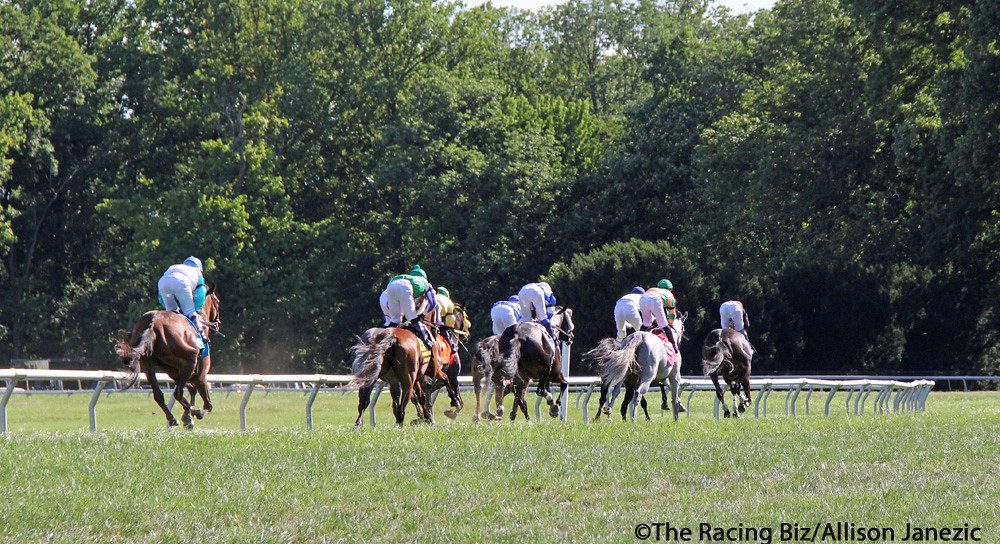
“Laurel obviously has a great turf course, and Pimlico is a smaller one. And so, as we race at Pimlico, this gives us the option now for giving it a break,” Knauf explained. “It’s probably going to be in the fall at some point where we can come back to Pimlico after our break, race for a stretch, then give it a little bit of a breather, and allow us to utilize Laurel, and can make it a special turf meet.”
Pimlico’s turf course is 70 feet wide, while Laurel’s is 142 feet wide. That added width allows Laurel, using temporary railings, to card races on two different courses each day, while all of Pimlico’s grass races each day must take place on the same course.
When it appeared that Shamrock would be the training center, such a plan was infeasible. But once the Shamrock initiative blew up at the end of 2025 into the beginning of this year, the MSA turned its eyes towards Laurel.
“[Racing] was not an option at Shamrock at all,” Knauf said. “But once the purchase of Laurel went through and it came back into the mix, we talked to the MSA about our needs for giving the Pimlico turf course a little bit of a break and keeping up with the rich tradition that Maryland has with turf racing, and they were amenable to this type of small season.”
One challenge, which Knauf acknowledged and the operating agreement alludes to, is the condition of Laurel Park’s buildings. A previous government study recommended that virtually all of the structures on the grounds, other than the paddock, be razed.
The operating agreement includes an “as-is” clause in which the sides agree that the “conditions of structures, backstretch housing, building systems, and other improvements at the Laurel Park facility are substandard and in need of remediation.”
But what funding there is for Laurel in the MSA budget must be dedicated to turning it into a training center, rather than readying its customer-facing facilities for future race meets.
“There’s only going to be a certain amount of money that can be spent at Laurel, and the backstretch is certainly the focus, the workforce housing, and that’s going to be the target,” Knauf said. “And as we move into the [grandstand], we’re just not sure how much funds will be remaining.”
Still, the signing of the agreement is another step into the future of Maryland racing. The reconstruction of Pimlico is moving forward – “the site is really starting to take shape now,” Knauf said. And the decision that Laurel will be part of that future, and not just as a training center, is good news for DC area racing fans.
“We feel like it was a good working compromise,” Knauf said. “I think we’re all in the same boat, rowing in the same direction. We’re happy it’s completed and we can get the planning stages for Laurel going.”
Pick up reliable and rewarding tickets for major events!
LATEST NEWS










Diane Hain
05th Nov 2026Who is paying the hundreds of millions of dollars it will take to replace the Laurel grandstand, which MEDCO proved to be even more structurally unsound than Pimlico was? https://dlslibrary.state.md.us/publications/MEDCO/HB897Ch61(3(e))(2022)_2022.pdf From the 2022 Maryland Economic Development Corporation (MEDCO) feasibility study: “In the basement area below the 1911 grandstand structure, there are excavated areas with shoring
posts, but several shoring posts appeared to have fallen loose and not engaged with the slab
above. Significant concrete distress is visible at the underside of the concrete slab, with corrosion
of steel reinforcement.
Additions or renovations to the structures would pose a challenge. A 2017 study by the firm ECS
on five concrete columns in the 1911 grandstand found that the reinforcement does not meet the
minimum required by the current building codes, and thus the columns would need to be
replaced if affected by added gravity or lateral loading from an alteration or addition.
The curtain wall shows evidence of leakage, missing and misplaced shims, and is in overall poor
condition with several major repair needs and deficiencies identified. Significant signs of water
management issues were identified requiring likely major repairs or replacement.
The report provides an overall rating index for each element of the facility and components
systems, ranging from 1 to 5, corresponding to a description of excellent, good, fair, poor or bad.
All component systems were found to have major deficiencies which place them beyond repair.
Of note:
• Roof: the roof of the grandstand, clubhouse and curtain wall received a rating of 5, or
“bad,” meaning replacement is required to restore functionality. The report recommended
a complete replacement of the roof membrane, and also noted significant corrosion of
original roof trusses, as well as evidence of significant moisture
infiltration.
• HVAC: the HVAC system of the grandstand and clubhouse received a rating of 5, or
“bad,” meaning replacement is required to restore functionality.
• Plumbing: the plumbing system of the grandstand and clubhouse received a rating of 4,
or “poor” meaning that significant repairs are required, does not meet all codes and is
obsolete.
• Electrical system: “bad” or 5 in Grandstand; “poor” or 4 in clubhouse.
Equipment in the Grandstand (1911) Building is failing and generally not suitable for re-use.
Plumbing systems are deteriorating and the fire protection systems at the Grandstand (1911)
Building and the Clubhouse (1953) Addition do not provide full coverage.
The backstretch buildings can be grouped into four categories: horse barns, wash
barns, dorms, and common facilities buildings. Backstretch buildings contain minimal to no fire
protection systems and minimal HVAC. Consultants have recommended demolishing all.
Housing facilities for workers that care for horses are in generally poor condition, and beyond
their usable life. For health and safety reasons, these housing units should be demolished and
replaced with high-quality structures that meet current codes and all applicable standards.
Several backstretch buildings were constructed without building permits, and have drawn the
attention of the State Fire Marshal and Anne Arundel county officials.
Notices were issued related to “dummy” hydrants in barn areas that are either not connected to
water or do not contain adequate water flow for suppression. Violation notices state that barns
did not undergo proper site development review, which would be necessary for violations to be
resolved.
Of note, interior finishes in public facing areas are in excellent to good condition given recent
renovations, including restaurants on clubhouse level and related lounges and common spaces.
There are portions of the property where preservation is recommended. An Historic Saddling
Paddock structure is considered in good condition. Constructed in the 1920s or early 1930s, it is
eligible for listing on the National Register of Historic Places for its representation of a
distinctive architectural typology, and the building therefore contains many original and
distinctive features.
Overall, however, it is the assessment of MEDCO real estate/development staff that the
structures at Laurel do not warrant additional investment, and demolition is the logical next step.”